
دليل شراء ورق إيصالات POS: حراري مقابل عادي مقابل كربون — المواصفات والتكلفة ولماذا يقتل الورق الرخيص رؤوس الطباعة
دليل شراء محايد للمورّد لورق إيصالات POS وATM والأكشاك — حراري مباشر مقابل عادي مقابل كربون، طلاءات BPA مقابل BPS مقابل خالية من الفينول، لماذا يدمر الورق خارج المواصفات الرؤوس، والست مواصفات التي يجب تأكيدها قبل طلب طبلية.
لماذا اختيار الورق أهم من اختيار الطابعة
The economics are easy to miss. A 80 mm × 80 m thermal roll costs USD 0.30 to 0.60 wholesale; a replacement Epson TM-T88 printhead lands at USD 60 to 95 plus a service-call cycle. Yet at most retail deployments we audit, paper is purchased on price alone — usually from whoever quoted the lowest number that quarter — while the printhead replacements are quietly written off as "regular wear." They are not. They are the direct, predictable consequence of buying off-spec paper.
A reputable Japan- or Korea-grade thermal roll runs your TM-T88V head to its rated 60 million-line life — about 4 to 5 years at 1,000 receipts a day. A no-spec commodity roll, with high silica filler and uneven coating, takes the same head out at the 18 to 24 month mark with the classic single-vertical-white-line failure pattern. The first-year savings on cheap paper (about USD 80 across a typical lane) get vaporised by the second-year head replacement (about USD 150 installed) plus the lost receipts during the outage.
أنواع الورق الثلاثة: حراري، عادي، كربون
Receipt printers run one of three paper types, and each has a clear use case. Mismatched paper is by far the most common field-failure cause for printers that look "defective" but are simply being asked to print on the wrong substrate.
| Print mechanism | Best for | Avoid for | |
|---|---|---|---|
| Direct thermal | Heat activates a chemical coating in the paper | Front-of-house POS, ATM receipts, banking, label printing | Hot environments (kitchens, sterilisers), long-term archival |
| Bond (plain) paper | Impact head strikes through inked ribbon onto plain paper | Kitchens, multi-part forms, warranty records, anything stored 5+ years | High-speed checkout (slow vs thermal), low-noise environments |
| Carbonless multi-part | Impact head strikes plain top sheet; chemical reactant transfers to copy sheet | Restaurant tickets (one for kitchen, one for guest), warranty paperwork, distribution slips | Anywhere a single copy suffices (waste), heat-affected pass-line stations |
A practical heuristic: thermal owns the customer-facing checkout lane, dot-matrix owns the kitchen and back-office, and carbonless owns any workflow where a paper copy needs to physically travel to two places. Most operations need at least two of the three.
الورق الحراري: المواصفات الست التي تهم فعلاً
Thermal rolls are not a commodity once you read the spec sheet. The six numbers below govern print quality, head life, and the cost-per-receipt math.
- 1
Basis weight (g/m²)
Standard POS thermal is 55–80 g/m². Lighter (45–55) is cheaper but tears more easily and curls in humid environments. 80 g/m² is the sweet spot for durability without paying for laminated overkill. - 2
Sensitivity (mJ/mm²)
Measures how much heat is needed to fully darken the coating. Modern paper is rated 0.20–0.25 mJ/mm² and matches the heat output of mainstream POS printers (Epson, Star, Bixolon set at default density). Below 0.18 → faint prints. Above 0.30 → wastes energy and battery on mobile printers. - 3
Filler content
Coatings include kaolin clay or calcium carbonate as a smoothing filler. Cheap rolls use cheaper, harder fillers (silica, ground limestone) that grind the printhead. Reputable suppliers state the filler chemistry; if not stated, ask. - 4
Coating uniformity
Premium rolls have ±2 % coating thickness variance across the roll. Bargain rolls vary 10 %+, producing variable print density even on a healthy head. Hard to test before purchase; a sample roll print-test is the only definitive check. - 5
Shelf life
Sealed in original packaging, premium phenol-free paper has a 3+ year shelf life. Bargain rolls degrade noticeably after 12 months — the coating loses sensitivity, prints fade. Buy what you'll consume in 12 months, not lifetime stockpiles. - 6
BPA / BPS / phenol-free status
Required disclosure in the EU and several US states. If the supplier won't tell you, that itself is a red flag. See next section.
BPA وBPS وحقيقة 'خالٍ من الفينول'
For two decades, bisphenol-A (BPA) was the standard developer chemical in direct-thermal paper. In 2010 the U.S. EPA published a BPA Action Plan citing endocrine-disruption concerns, and the EU followed with REACH restrictions; by January 2020 the EU banned thermal papers containing BPA at concentrations above 0.02 % by weight. Most paper sold today is labelled "BPA-free."
Read the fine print on those rolls. The most common BPA substitute is bisphenol-S (BPS), structurally similar enough that several peer-reviewed studies have shown comparable endocrine activity in mammalian cell lines. "BPA-free" rolls that quietly use BPS are a regulatory pass but not a meaningful safety improvement.
True "phenol-free" thermal paper uses one of two newer developers: Pergafast 201 (a sulfonyl-urea, no bisphenol structure at all) or Vitamin-C-based developers (ascorbic acid derivatives). These rolls carry a clear "phenol-free" declaration on the box and typically cost 10–25 % more than BPS-containing alternatives.
لماذا يقتل الورق الحراري الرخيص رؤوس الطباعة (آلية التآكل)
The single most common cause of premature printhead death in a high-volume retail lane is the wrong paper — not heat, not voltage sags, not ESD. The mechanism is mechanical, not chemical.
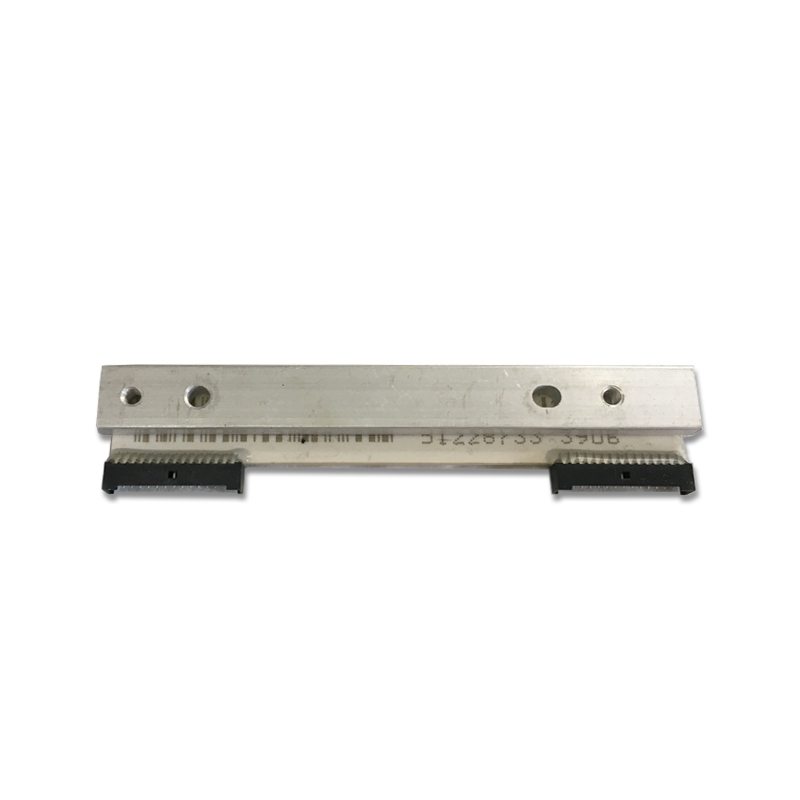
A thermal printhead's active surface is a glass-protected array of thousands of microscopic heating elements. The glass layer (about 5–10 µm thick on a quality head) protects the elements from the slight abrasion of every printed line. On reputable paper, that glass survives the rated 60 million lines. On cheap paper, the high-hardness filler particles (silica, ground limestone) act like wet-sanding under pressure. The glass layer wears through unevenly — at first, fine; then suddenly, an individual heating element is exposed, oxidises, and dies. Visible result:
Heads with two or three dropped columns are still usable; with ten or more, receipts are unreadable and EAN/UPC barcodes (printed on the receipt for returns) become unscannable. At that point the head is end-of-life. A switch to quality paper after the damage is done doesn't reverse it; the glass layer doesn't regrow. Prevention is the only cure.
الكربون والورق العادي: متى تكون الطباعة بالاصطدام لا تزال الحل
The reason kitchens still run dot-matrix printers in 2026 is not inertia. Direct-thermal paper darkens fully at around 70 °C (158 °F), and a hot kitchen pass routinely sits at 60 °C or higher. Receipts left on the pass for more than 15–20 minutes turn solid black and become unreadable. We have customers in quick-serve operations who paid for an "upgrade" to thermal kitchen printers, then quietly reverted to dot-matrix six months later when the chef gave up on the all-black tickets.
Carbonless multi-part paper is the other category dot-matrix owns uniquely. A two-part carbonless roll on an Epson TM-U220 produces one ticket for the kitchen and one for the front, in a single print pass, no thermal copy required. Three-part rolls add a third copy for the chef's line. Bond paper alone produces only the original; you need carbonless for multi-station distribution.
حجم اللفة وقطر اللب: قائمة فحص المطابقة
Once you have the paper grade right, fitting the printer is a dimensional check on four numbers:
| Most common | Where it varies | |
|---|---|---|
| Roll width | 80 mm (full-size POS thermal) | 58 mm (compact / mobile POS); 76 mm (kitchen / impact); 112 mm (label or wide-format) |
| Outside diameter | 80 mm OD | Some compact printers cap at 50–60 mm OD; large bin-load printers accept 100+ mm OD |
| Core inside diameter | 12 mm (½") | 25 mm (1") on industrial and some label printers; 22 mm on certain Star units |
| Roll length | 80 m for 80 mm wide rolls | 30–50 m for compact rolls; 200+ m for high-volume self-service |
If the roll is 1 mm too wide, it jams or skews. If the core is 12 mm and the printer expects 25 mm, the roll wobbles on the spindle and feeds unevenly. Always confirm the printer's maximum-OD and core-ID specifications before bulk ordering — the numbers are in the printer manual, usually under "paper specifications."
ما يجب سؤال مورد الورق قبل الالتزام
Before committing to a pallet (typically 10,000+ rolls), get a sample carton (50 rolls) and run the following 5-point check:
- Print 100 receipts at your printer's default density setting. Print quality should be uniformly dark from line 1 to line 100; if it dims, the coating is uneven or the sensitivity is below spec.
- Cut a 10 cm strip and hold it under a 60 °C heat source for 10 minutes. Premium phenol-free paper darkens only mildly; cheap paper goes uniformly black. This is the heat-tolerance check that predicts kitchen-pass survival.
- Scratch the printed receipt with a fingernail. Quality coating resists; bargain coating flakes off in 30 seconds.
- Leave a printed receipt taped to a sunny window for 14 days. Quality direct-thermal will be readable; bargain stock will be faded to illegible.
- Ask the supplier for the spec sheet showing basis weight, sensitivity in mJ/mm², BPA / BPS / phenol-free status, and shelf life. No spec sheet = walk away.
On price, expect to pay 10–25 % more for documented phenol-free paper from a known-source factory than for unbranded commodity stock. Across a 5-year deployment, that premium pays for itself in extended printhead life within the first 14 months for any high-volume lane. For low-volume back-office printers (under 50 receipts a week), bargain commodity may be fine — but document the choice rather than letting procurement drift to the cheapest line item by default.
الأسئلة الشائعة
هل كل ورق إيصالات حراري قابل للتبادل؟
ما هو الورق الحراري 'الخالي من BPA' وهل هو أأمن؟
كم تظل الإيصالات الحرارية مقروءة؟
لماذا تخرج إيصالاتي باهتة رغم لفة جديدة؟
هل أستخدم ورقًا عاديًا في طابعة حرارية إذا نفد الحراري؟
هل اللفات التي يبيعها مورد POS أفضل من لفات السوق؟
المصادر والمراجع الإضافية
- Thermal Paper Standards and Test Methods (ECMA-379) — Ecma International
- Bisphenol A (BPA) action plan — Existing Chemicals — U.S. EPA
- Thermal Print Quality Specifications and Paper Compatibility — Epson America Developer Center
- Receipt paper grades — direct thermal coating chemistry — Koehler Paper
- Selecting Thermal Media for Zebra Printers — Zebra Technologies
أدلة ذات صلة
أجهزة POS المدمجة مقابل المعيارية: أيّها تشتري (وكيف يؤثّر كلٌّ في الإصلاحات)
المدمج أنيق وسريع النشر؛ والمعياري مرن وأرخص في الترقية والإصلاح. الجواب الصحيح يعتمد على حجمك وخطط نموّك — وكيف تريد التعامل مع الأعطال.
اقرأ الدليل →دليل شراء ماسح الباركود: ليزر 1D مقابل مصوّر 2D، سلكي مقابل لاسلكي، يدوي مقابل بلا يدين
سؤالان يحسمان الأغلب: هل تمسح شاشات هواتف (إذًا 2D)، وهل منضدتك مزدحمة بما يكفي لتريد بلا يدين؟ إليك كيف تتطابق التقنية والشكل والاتصال مع الاستخدام الفعلي.
اقرأ الدليل →قاطعات طابعة الإيصالات الأوتوماتيكية: مقصلة مقابل دوّارة، قطع جزئي مقابل كامل، وعمر الشفرة
مقصلة أم دوّارة؟ قطع جزئي أم كامل؟ القاطعة هي القطعة المتحرّكة الأكثر استخدامًا في طابعة الإيصالات — النوع والوضع الصحيحان يبقيان الممر سريعًا والإيصالات مرتّبة.
اقرأ الدليل →فئات ذات صلة
قطع غيار مميزة

هل تحتاج إلى القطع المذكورة في هذا الدليل؟
قطع OEM أصلية وبدائل مختبرة في المصنع لأنظمة IBM و Toshiba و NCR و Diebold و Wincor و Hyosung — مع شحن عالمي.