
Balance commerciale qui pèse mal ? Mise à niveau, calibrage, test des capteurs et règles métrologie légale
Un guide pratique pour une balance commerciale qui dérive, affiche faux ou ne se met pas à zéro — comment fonctionne une balance à capteur de charge, une séquence niveler-nettoyer-calibrer, le test et le remplacement des capteurs, et les règles de métrologie légale à ne pas enfreindre.
Le tri rapide
An inaccurate retail scale rarely has a dead load cell. Far more often it’s un-level, something is touching the platter, or it simply needs re-zeroing or calibration. And before you reach for tools, one rule overrides everything: if the scale is used to sell goods by weight, it’s legal for trade — you may level and clean it, but calibration must be done by a certified technician. Start here:
| Do this | Why it works | |
|---|---|---|
| 1. Level the scale | An out-of-level scale reads wrong even with a perfect load cell | — |
| 2. Clear the platter and gap | Debris, a leaning wall or a stray cable foul the reading | — |
| 3. Re-zero with nothing on it | Clears a non-zero empty reading and minor drift | — |
| 4. Check the environment | Vibration, draft, water and an unstable floor all degrade accuracy | — |
| 5. Calibrate / test load cell | Certified tech for trade scales; load-cell test if still off | — |
Comment une balance commerciale pèse
Almost every retail scale works the same way: a load cell — a metal element with bonded strain gauges — flexes microscopically under the weight on the platter. That flex changes the gauges’ electrical resistance, producing a tiny signal proportional to the load, which the indicator/terminal amplifies, converts and displays as a weight (and a price).
Because the load cell measures a microscopic flex, the scale is exquisitely sensitive to anything else that pushes on it: an out-of-level stand, a platter touching a wall, vibration, a draft, or moisture in the junction box. That sensitivity is why most accuracy problems are mechanical or environmental — not the cell itself.
Lire le symptôme
The symptom points to the cause. Match yours before assuming the worst:
| Symptom | Most likely cause | |
|---|---|---|
| Reads a bit high or low everywhere | Needs calibration, or not level | — |
| Won't return to zero when empty | Re-zero needed, or platter binding/fouled | — |
| Reading drifts or jumps | Vibration, draft, or moisture in the junction box | — |
| Wrong only at heavy loads | Load cell out of spec or near overload damage | — |
| Unstable, never settles | Unstable floor, airflow, or loose wiring | — |
| No reading / error code | Power, cable, junction box, or failed load cell | — |
Diagnostic pas à pas
Work the sequence in order. The first four steps are yours to do; the last is where a legal-for-trade scale hands off to a certified technician.
- 1
Level it
Use the built-in bubble level and adjustable feet until the bubble is centered. An out-of-level scale is the single most common accuracy fault. - 2
Clear and inspect the platter
Remove the platter, clean underneath and around the gap, and make sure nothing — debris, a wall, a cable — touches or binds it. Refit and re-zero. - 3
Check the environment
Move the scale away from vibration sources and drafts, onto a stable level surface, and dry up any standing water. Let it acclimatize to room temperature.Caution: Standing water around or under the scale both skews readings and can damage the load cell and junction box. - 4
Inspect the junction box and wiring
Open the load-cell junction box and check for moisture, corrosion, foreign material, loose terminals, or insulation touching contacts. Dry it out and re-tighten — these faults mimic a bad cell. - 5
Calibrate or test the load cell
Still off? For a legal-for-trade scale, call a certified technician to calibrate and re-seal. For non-trade scales, calibrate with certified test weights, and if it still fails, test the load cell (next section).
Calibrage et règles de métrologie légale
Calibration corrects the scale’s zero and span against known weights. Who may do it depends entirely on whether the scale is used for trade:
| Scenario | Who calibrates / rules | |
|---|---|---|
| Legal-for-trade (selling by weight) | Authorized, certified technician only; sealed & verified | — |
| Internal / non-trade use | You may calibrate with certified traceable test weights | — |
| After any load-cell repair | Recalibrate; trade scales must be re-sealed by a certified tech | — |
| Periodic verification | On the schedule your local weights-and-measures rules require | — |
| Test weights | Use certified, traceable weights — not random objects | — |
Tester et trouver capteurs et pièces
If the scale is level, clean and calibrated but still wrong — especially at heavier loads — the load cell is the prime suspect. Confirm it before replacing:
| Check | What it tells you | |
|---|---|---|
| Input/output resistance vs spec | Far off the rated value = suspect cell | — |
| Zero balance (no load) | Large offset = damaged or overloaded cell | — |
| Junction box condition | Moisture/corrosion can mimic a bad cell — fix first | — |
| Reading at heavy load | Wrong only when loaded points to the cell | — |
| Visible damage | Bent/deformed cell from overload = replace | — |
Browse load cells, indicators and spare parts in our Mettler Toledo scales & spare parts category, and related boards and supplies in POS terminal repair parts. If the fault is a dead indicator or terminal rather than the cell, a power problem may be to blame — see our power supply failure diagnosis guide. Send us your scale model and load-cell rating and we’ll match the right part — and remember a legal-for-trade scale must be recalibrated and re-sealed by a certified technician after the repair.
Questions fréquentes
Ma balance commerciale pèse faux — quoi vérifier en premier ?
Pourquoi l'affichage dérive-t-il ou ne revient-il pas à zéro ?
Puis-je calibrer moi-même une balance soumise à la métrologie légale ?
Comment tester si un capteur de charge est défectueux ?
L'environnement affecte-t-il vraiment la précision ?
Quand remplacer un capteur plutôt que toute la balance ?
Sources & lectures complémentaires
- Load Cell Testing Tips / Installation Guide — METTLER TOLEDO
- How to Solve the Most Common Scale Problem — METTLER TOLEDO
- How to Calibrate a Mettler Toledo Load Cell, Step by Step — Fibos
- How to Calibrate Your Mettler Toledo Scales — Alliance Scale
- Mettler Toledo Troubleshooting — It Still Works
Guides associés
Pourquoi les tickets thermiques s'effacent — et comment stocker le papier thermique pour que les impressions durent
Une impression thermique n'est pas de l'encre — c'est une marque chimique déclenchée par la chaleur que plus de chaleur, de lumière, d'humidité ou d'huile peut effacer. Voici pourquoi les tickets s'effacent, combien de temps ils durent vraiment, et comment stocker ceux qui comptent.
Lire le guide →Terminal POS en surchauffe : causes, refroidissement, remplacement du ventilateur et calendrier de maintenance
Un terminal POS qui redémarre au coup de feu du midi ou chauffe au toucher a presque toujours un problème de refroidissement — poussière, ventilateur mourant ou flux d'air bloqué. Voici comment le refroidir aujourd'hui et un calendrier pour que ça ne recommence pas.
Lire le guide →Checklist de maintenance préventive POS : un calendrier composant par composant qui évite les pannes
Presque chaque intervention d'urgence — une tête morte, un scanner qui ne lit pas, un terminal qui surchauffe — est un nettoyage manqué. Voici la routine planifiée qui transforme les réparations réactives en une habitude de cinq minutes.
Lire le guide →Catégories associées
Pièces en vedette

Tête d'impression thermique Mettler Toledo IMPACT S / IMPACT M pour balance de traiteur numérique
%20Sparta%20Riser%20Card/120c399634d85265f7a7595a979407ee_c48b4b186f0a2eea2b86d0d5a86c219e_s-l1600.jpg)
IBM 44V2036 SurePOS 300 (8410-E40) Carte Riser Sparta
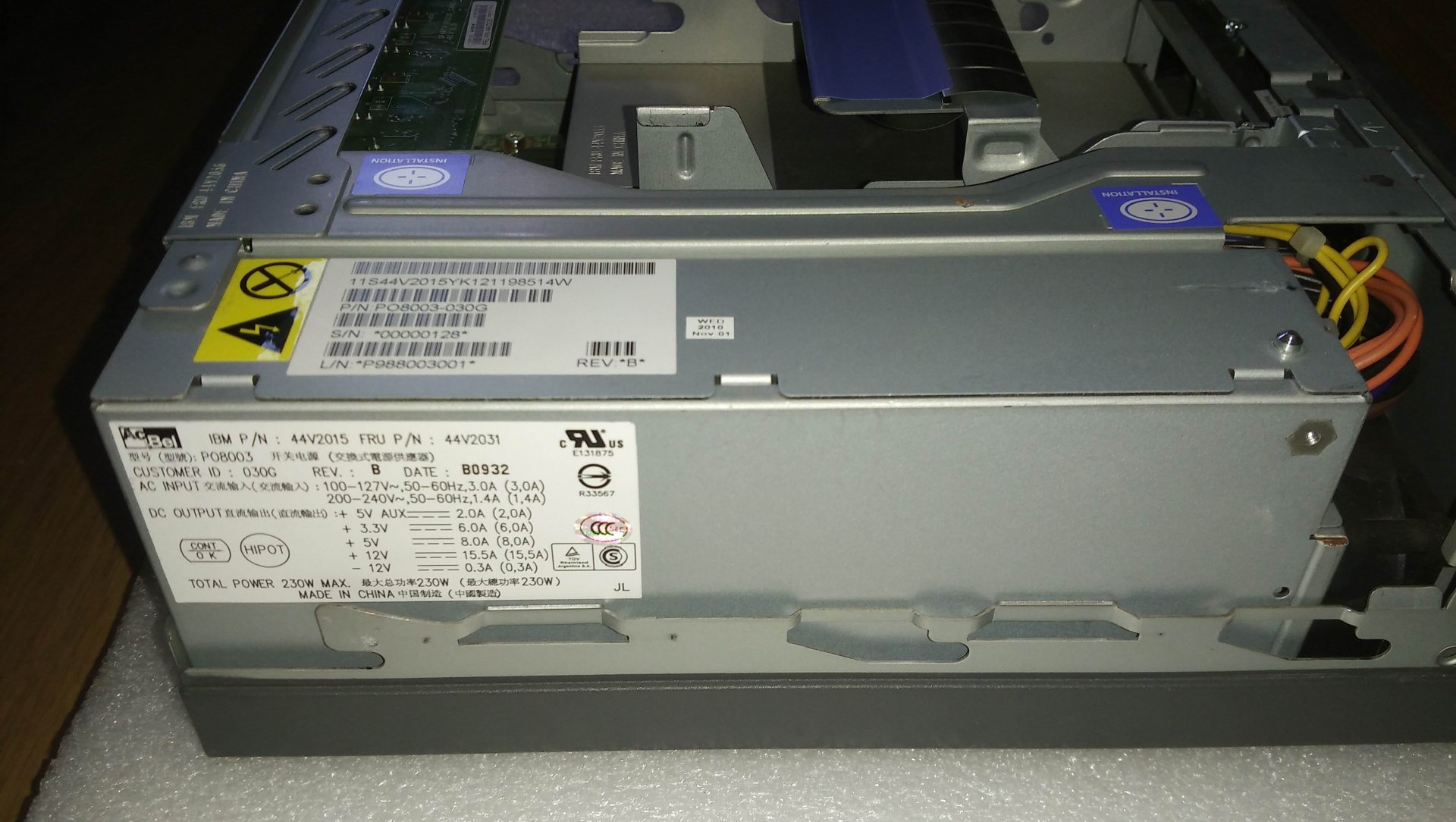
Alimentation terminal POS IBM 4810-340 4810-E40 PN44V2015 44V2031 ACBEL P08003

Tête d'impression Mettler Toledo KD2002-GC10 pour imprimante de balance PC Toledo
Besoin des pièces mentionnées dans ce guide ?
Pièces OEM d'origine et alternatives testées en usine pour les systèmes IBM, Toshiba, NCR, Diebold, Wincor et Hyosung — avec expédition mondiale.