
¿La balanza comercial no pesa con precisión? Nivelación, calibración, prueba de celdas y reglas de uso legal
Una guía práctica para una balanza comercial que deriva, marca mal o no se pone a cero — cómo funciona una balanza de celda de carga, una secuencia nivelar-limpiar-calibrar, prueba y reemplazo de celdas de carga, y las reglas de uso legal que no debe romper.
El triaje rápido
An inaccurate retail scale rarely has a dead load cell. Far more often it’s un-level, something is touching the platter, or it simply needs re-zeroing or calibration. And before you reach for tools, one rule overrides everything: if the scale is used to sell goods by weight, it’s legal for trade — you may level and clean it, but calibration must be done by a certified technician. Start here:
| Do this | Why it works | |
|---|---|---|
| 1. Level the scale | An out-of-level scale reads wrong even with a perfect load cell | — |
| 2. Clear the platter and gap | Debris, a leaning wall or a stray cable foul the reading | — |
| 3. Re-zero with nothing on it | Clears a non-zero empty reading and minor drift | — |
| 4. Check the environment | Vibration, draft, water and an unstable floor all degrade accuracy | — |
| 5. Calibrate / test load cell | Certified tech for trade scales; load-cell test if still off | — |
Cómo pesa una balanza comercial
Almost every retail scale works the same way: a load cell — a metal element with bonded strain gauges — flexes microscopically under the weight on the platter. That flex changes the gauges’ electrical resistance, producing a tiny signal proportional to the load, which the indicator/terminal amplifies, converts and displays as a weight (and a price).
Because the load cell measures a microscopic flex, the scale is exquisitely sensitive to anything else that pushes on it: an out-of-level stand, a platter touching a wall, vibration, a draft, or moisture in the junction box. That sensitivity is why most accuracy problems are mechanical or environmental — not the cell itself.
Leer el síntoma
The symptom points to the cause. Match yours before assuming the worst:
| Symptom | Most likely cause | |
|---|---|---|
| Reads a bit high or low everywhere | Needs calibration, or not level | — |
| Won't return to zero when empty | Re-zero needed, or platter binding/fouled | — |
| Reading drifts or jumps | Vibration, draft, or moisture in the junction box | — |
| Wrong only at heavy loads | Load cell out of spec or near overload damage | — |
| Unstable, never settles | Unstable floor, airflow, or loose wiring | — |
| No reading / error code | Power, cable, junction box, or failed load cell | — |
Diagnóstico paso a paso
Work the sequence in order. The first four steps are yours to do; the last is where a legal-for-trade scale hands off to a certified technician.
- 1
Level it
Use the built-in bubble level and adjustable feet until the bubble is centered. An out-of-level scale is the single most common accuracy fault. - 2
Clear and inspect the platter
Remove the platter, clean underneath and around the gap, and make sure nothing — debris, a wall, a cable — touches or binds it. Refit and re-zero. - 3
Check the environment
Move the scale away from vibration sources and drafts, onto a stable level surface, and dry up any standing water. Let it acclimatize to room temperature.Caution: Standing water around or under the scale both skews readings and can damage the load cell and junction box. - 4
Inspect the junction box and wiring
Open the load-cell junction box and check for moisture, corrosion, foreign material, loose terminals, or insulation touching contacts. Dry it out and re-tighten — these faults mimic a bad cell. - 5
Calibrate or test the load cell
Still off? For a legal-for-trade scale, call a certified technician to calibrate and re-seal. For non-trade scales, calibrate with certified test weights, and if it still fails, test the load cell (next section).
Calibración y reglas de uso legal
Calibration corrects the scale’s zero and span against known weights. Who may do it depends entirely on whether the scale is used for trade:
| Scenario | Who calibrates / rules | |
|---|---|---|
| Legal-for-trade (selling by weight) | Authorized, certified technician only; sealed & verified | — |
| Internal / non-trade use | You may calibrate with certified traceable test weights | — |
| After any load-cell repair | Recalibrate; trade scales must be re-sealed by a certified tech | — |
| Periodic verification | On the schedule your local weights-and-measures rules require | — |
| Test weights | Use certified, traceable weights — not random objects | — |
Probar y conseguir celdas de carga y piezas
If the scale is level, clean and calibrated but still wrong — especially at heavier loads — the load cell is the prime suspect. Confirm it before replacing:
| Check | What it tells you | |
|---|---|---|
| Input/output resistance vs spec | Far off the rated value = suspect cell | — |
| Zero balance (no load) | Large offset = damaged or overloaded cell | — |
| Junction box condition | Moisture/corrosion can mimic a bad cell — fix first | — |
| Reading at heavy load | Wrong only when loaded points to the cell | — |
| Visible damage | Bent/deformed cell from overload = replace | — |
Browse load cells, indicators and spare parts in our Mettler Toledo scales & spare parts category, and related boards and supplies in POS terminal repair parts. If the fault is a dead indicator or terminal rather than the cell, a power problem may be to blame — see our power supply failure diagnosis guide. Send us your scale model and load-cell rating and we’ll match the right part — and remember a legal-for-trade scale must be recalibrated and re-sealed by a certified technician after the repair.
Preguntas frecuentes
Mi balanza comercial pesa mal — ¿qué reviso primero?
¿Por qué deriva la lectura o no vuelve a cero?
¿Puedo calibrar yo mismo una balanza de uso legal?
¿Cómo pruebo si una celda de carga está averiada?
¿De verdad afecta el entorno a la precisión?
¿Cuándo reemplazo una celda en vez de toda la balanza?
Fuentes y lecturas complementarias
- Load Cell Testing Tips / Installation Guide — METTLER TOLEDO
- How to Solve the Most Common Scale Problem — METTLER TOLEDO
- How to Calibrate a Mettler Toledo Load Cell, Step by Step — Fibos
- How to Calibrate Your Mettler Toledo Scales — Alliance Scale
- Mettler Toledo Troubleshooting — It Still Works
Guías relacionadas
Por qué se desvanecen los recibos térmicos — y cómo almacenar papel térmico para que las impresiones duren
Una impresión térmica no es tinta — es una marca química activada por calor que más calor, luz, humedad o aceite puede borrar. Aquí está por qué se desvanecen los recibos, cuánto duran realmente, y cómo almacenar los que importan.
Leer guía →Terminal POS sobrecalentándose: causas, refrigeración, reemplazo del ventilador y un plan de mantenimiento
Un terminal POS que se reinicia en la hora punta del almuerzo o quema al tacto casi siempre tiene un problema de refrigeración — polvo, un ventilador muriendo o flujo de aire bloqueado. Aquí está cómo enfriarlo hoy y un plan para que no vuelva a pasar.
Leer guía →Lista de mantenimiento preventivo POS: un calendario componente por componente que evita el tiempo de inactividad
Casi cada aviso de emergencia — un cabezal muerto, un escáner que no lee, un terminal que se sobrecalienta — es una limpieza omitida. Aquí está la rutina programada que convierte las reparaciones reactivas en un hábito de cinco minutos.
Leer guía →Categorías relacionadas
Repuestos destacados

Cabezal de impresión térmico Mettler Toledo IMPACT S / IMPACT M para balanza digital de charcutería
%20Sparta%20Riser%20Card/120c399634d85265f7a7595a979407ee_c48b4b186f0a2eea2b86d0d5a86c219e_s-l1600.jpg)
IBM 44V2036 SurePOS 300 (8410-E40) Tarjeta Riser Sparta
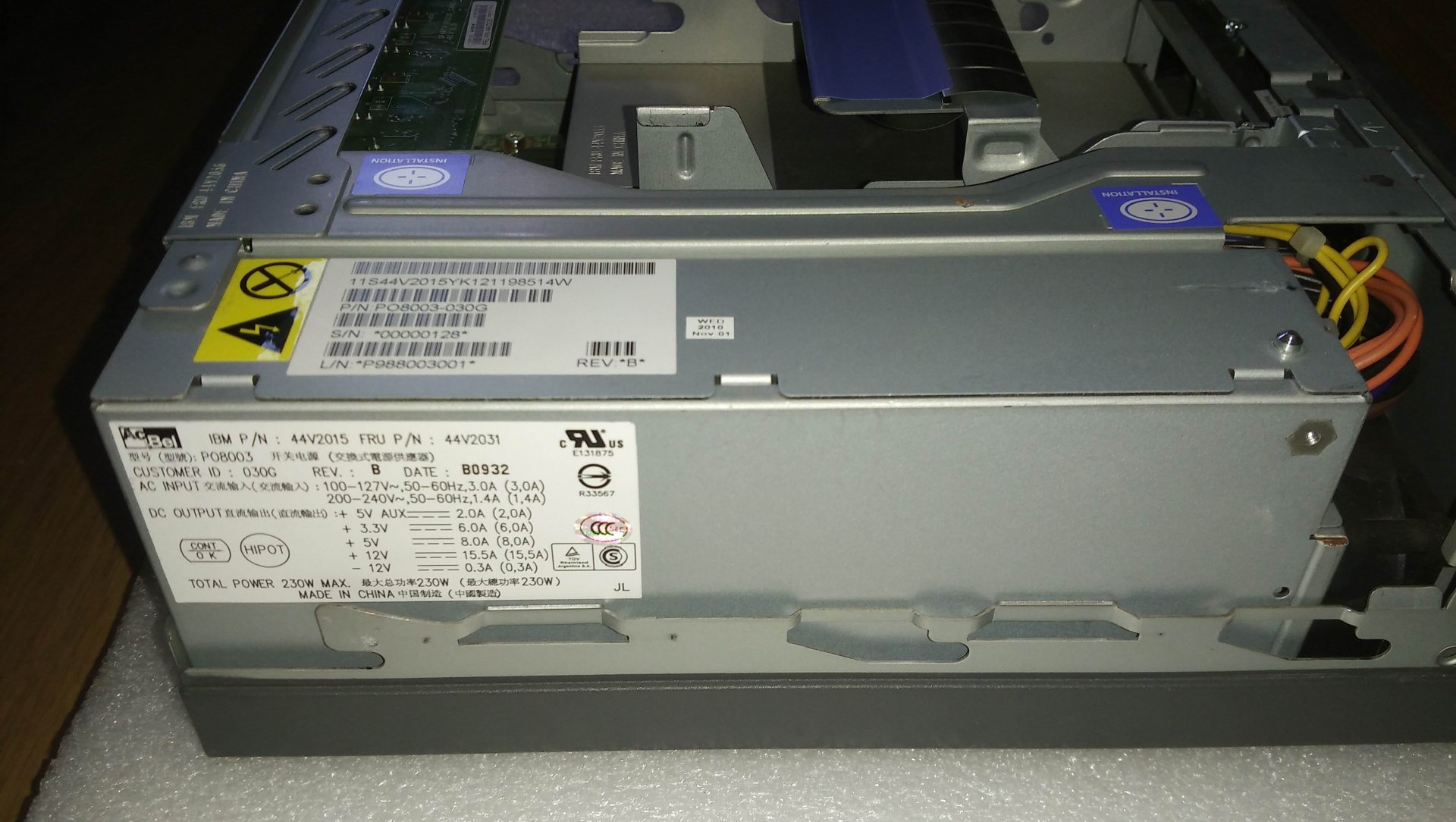
Fuente de alimentación terminal POS IBM 4810-340 4810-E40 PN44V2015 44V2031 ACBEL P08003

Cabezal de impresión Mettler Toledo KD2002-GC10 para impresora de balanza PC Toledo
¿Necesita las piezas mencionadas en esta guía?
Piezas OEM originales y alternativas probadas en fábrica para sistemas IBM, Toshiba, NCR, Diebold, Wincor y Hyosung — con envío mundial.